Simaudio Moon 860A v2 Stereo/Mono Amplifier $19,500 Review
January 15, 2022 Comments Off on Simaudio Moon 860A v2 Stereo/Mono Amplifier $19,500 Review
But if my seven numbers ever came up on that lottery ticket I never buy, there’s no question in my mind that I’d give the 4B3 to my brother-in-law and pick up a Simaudio or two. Why? Well, it’s undoubtedly a matter of degree. Where the Bryston provides a quiet, clear background, the Simaudio ups the ante by a hair, adding just a touch more depth to the soundstage. The Simaudio is just a touch more restrained in the highs, nipping just a leetle bit off the top of cymbals and sibilants, which is more to my own personal taste.
The main difference between these two amplifiers is more of an overall presentation thing. For an extra $13k or so, you get a more sophisticated-sounding amplifier, one that can more realistically rebuild the original recording space in your very own listening room.
It didn’t take long for me to determine that—yes—the 860A v2 is the better-sounding amplifier. Rather, it took me a long time to figure out why and to distill my thoughts in a coherent manner. And that’s really as it should be—throwing more money at a problem can only go so far in audio, and when you get to these extremely high-end products, improvement is no small feat.
Jason is sad
Simaudio has done it, though. With the 860A v2, they’ve made an amp that’s notably better than my own Bryston, which is already really, really good. The 860A v2 is a true statement product. Without even listening to the thing, it’s easy to see that this amp exudes quality and workmanship.
Really—there’s nothing about the 860A v2 that I didn’t like. Searching back over my time with this amp, I honestly can’t think of any areas for improvement, in either sound quality, build, or functionality. That is truly rare for me, as I can usually muster some sort of quibble, something I’d like to change. But that’s not the case here.


PrimaLuna EVO 300 Hybrid Integrated Amplifier Review
January 11, 2022 Comments Off on PrimaLuna EVO 300 Hybrid Integrated Amplifier Review
https://www.stereonet.com/au/reviews/primaluna-evo-300-hybrid-integrated-amplifier-review
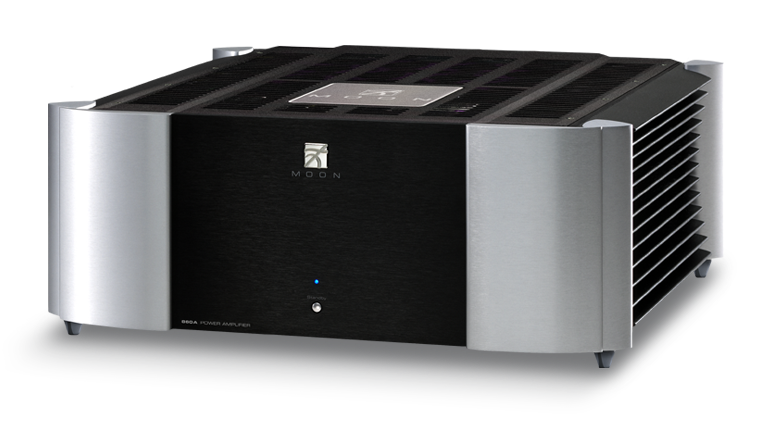
PrimaLuna has achieved a fine feat with the EVO 300 Hybrid, conjoining the best aspects of both valve and solid-state into a reasonably affordable amplifier that sounds thoroughly modern, transparent, open and enjoyable. Its general punch and bass heft will suit those with inefficient loudspeakers or large listening rooms, but this amplifier also works wonders with smaller sized loudspeakers – letting them reach their full potential. The pricing of this amplifier is where it should be and is good value compared to separates but without all the fussiness. Do try to audition it – you may just walk out of your local dealer with it under your arm, if you’re strong enough!

Enleum AMP-23R integrated amplifier £5,495 Review
January 7, 2022 Comments Off on Enleum AMP-23R integrated amplifier £5,495 Review
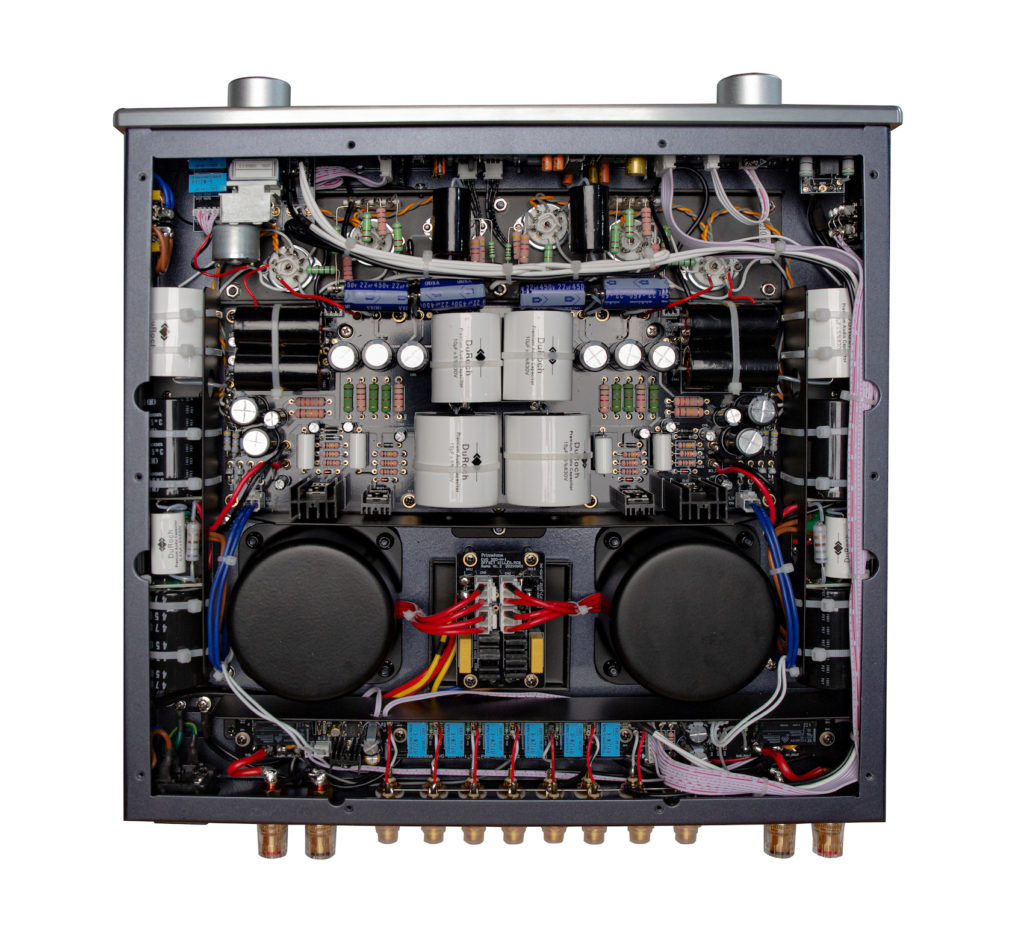
This amplifier does all the hi-fi stuff well; it images precisely, has plenty of punch and delivers voices like you wouldn’t believe. I put on the first Nicks/Buckingham Fleetwood Mac [Fleetwood Mac, Warner] album to hear ‘Landslide’ which was lovely but decided that ‘World Keep Turning’ is equally good, that never seemed the case in the past. And that’s a rare and valuable quality in any piece of audio gear, showing the listener just how good the music really is. A lot of stuff makes the better recordings sound great but fails to reveal the musical beauty of less polished productions, but the Enleum gets to the heart and soul of the matter in a very convincing style. Its low power output does limit speaker choice to an extent and headbangers will have to find really sensitive models to get their fix. But music lovers are catered for very well indeed, and that’s before we hear what Enleum’s proprietary connectors can do.
NAD C338 Hybrid Digital Integrated Amplifier Review
January 6, 2022 Comments Off on NAD C338 Hybrid Digital Integrated Amplifier Review
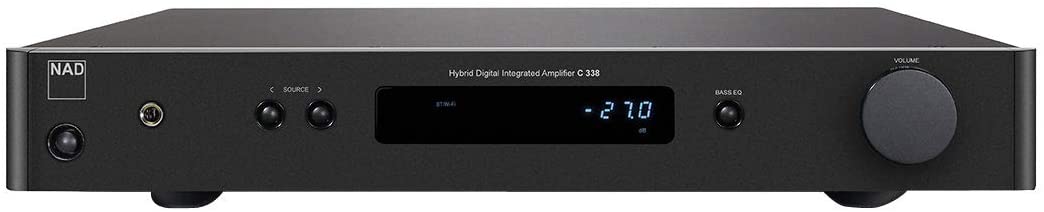
To my pleasant surprise the onboard DAC proved to be a very fine reproducer and I found little difference between the dual Wolfson DACs in the Cambridge unit (one per channel) and the single Burr Brown DAC onboard the C338. There was a very slight loss of ultimate definition and air, but little else of note. The digital inputs, like the phono input, seem very robust and offered extra definitional insight into the music when compared to the two line level inputs. I was immediately impressed and thought this would bode well for the ‘streaming phase’ of the review which requires a separate set-up discussion.
What is really noticeable is that on all inputs the NAD Class D design allows you to really open up the volume control. I am not used to listening at thundering levels, but the clarity of the amp keeps begging you to push the volume levels up to really high marks. As the volume increases so does the PRaT. Rhythm and timing are a bit underwhelming at low volume levels but as the volume levels rise the NAD C338 comes on strong and shakes your booty. I think this is because the Class D design, while able to deliver 50 watts (8 and 4 ohms) continuous, has the potential to deliver up to 150 watts of dynamic power and 300 watts peak. So my message is that if you like to ‘let her rip’ then this could be your amp

Balanced Audio Technology VK80i Integrated Amplifier $9995 Review
January 4, 2022 Comments Off on Balanced Audio Technology VK80i Integrated Amplifier $9995 Review
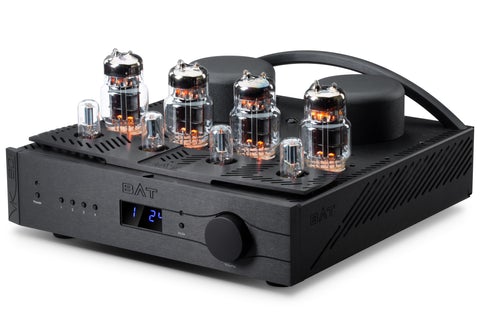
Next in line for the BAT was the Innersound Isis 3.5 electrostatic hybrid, one of the most cohesive hybrids I’ve ever auditioned, and a challenging capacitive load in the treble range. Hooked up to the Low impedance taps, the Innersound Isis sang sweetly with superb timbre fidelity. And soundstage transparency was spectacular. The BAT seemed totally unfazed by this load and coaxed plenty of dynamics from a speaker that usually requires solid-state muscle amplification
Kudos to the BAT team for launching the all-tube VK80i. It is above all else a superb demonstration of triode power. If you’ve been mired in an audio rut, living with a cookie-cutter push-pull beam power or pentode amp, listen up. Sonic happiness in a glass bottle is within reach. You owe it to yourself to audition the VK80i. You’ll discover as I did that there is no turning back.

AGD Tempo di GaN Stereo Amplifier $5500 Review
January 1, 2022 Comments Off on AGD Tempo di GaN Stereo Amplifier $5500 Review
http://www.enjoythemusic.com/magazine/equipment/1221/AGD_Tempo_di_GaN_Stereo_Amplifier_Review.htm
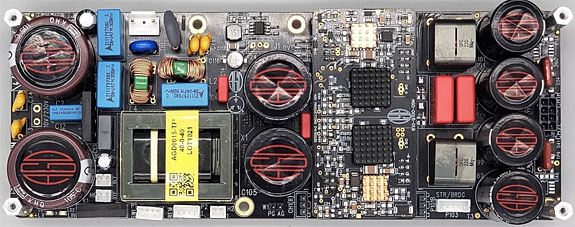
Actually, the name is “Tempo di GaN” so the “GaN” is easily identified as the Gallium Nitride FETs that are used in the amp. And yes, “di” is “of”. The duality comes into play with “Tempo” which in one sense is the rhythm of music or “rhythm of GaN” which is noticeably faster than with MOSFET transistors. The rise time or attack of the recorded music seems the same as the real-time in which it was performed. The music happens “right now!” And it happens without audible overshoot or irritation. It gives the music an immediacy and presence unlike MOSFETs or tube amplification. And a sense of dynamics that are not “off the charts” but pretty much “define the charts.”
All of which is to say that the proper execution of GaNFET technology is a very significant step toward experiencing recorded music as “live.” It doesn’t give us everything we need (yet?), but it seems to have conquered issues around pace, rhythm, and timing just as computer-regulated speed control has done for analog turntables and digital front ends. Resolution is as sharp as electrostatic speakers give us in the midrange and treble, and stays just as sharp into the low bass.
If you get the sense that I’m telling you GaNFET transistors are a game-changer, you’ve stumbled onto the second half of Alberto’s double entendre. “Tempo” is also “time” and yes, this is the era of GaNFET technology — not only for high-end audio, but other fields as well. There will always be lovers of tube technology, just as there are still lovers of sailboats, but if you are in the solid-state camp, either as a manufacturer or a listener, you need to be listening with GaNFETs.


Jadis Diapason Luxe Integrated Amplifier Review
December 31, 2021 Comments Off on Jadis Diapason Luxe Integrated Amplifier Review
https://www.hifinews.com/content/jadis-diapason-luxe-integrated-amplifier
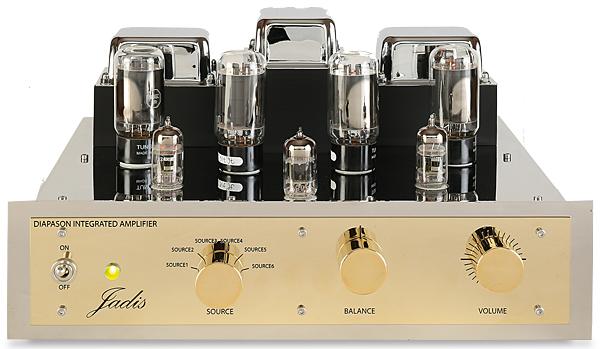
The result is something that sounds especially inviting, appealing and beguiling – far more so than you’d expect from most similarly priced solid-state designs. The Diapason Luxe goes about reproducing music in a completely different way to most mainstream amplifiers, one that’s strongly appealing to a certain type of listener and/or music fan. On the other hand, it has conspicuous limitations that mean it is not for all. Perplexingly however, it often makes the listener forget these, to the extent that even ardent valve critics may be left grumpily admitting that it sounds ‘rather gorgeous’.
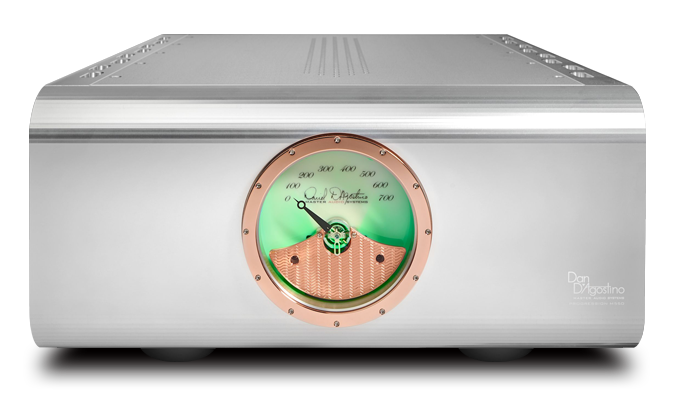
D’Agostino Master Audio Systems Progression M550
December 28, 2021 Comments Off on D’Agostino Master Audio Systems Progression M550
Audiophiles tend to fall into either the measurements camp or the listening camp. Not unlike politics, the debates that ensue get downright contentious. Personally, I’ve never felt the urge to define myself in this way. I like more data, not less, and therefore, when I’m compiling info to base a buying decision on, I prefer to consider my own listening tests in conjunction with a set of comprehensive measurements. Where the positive results from both tests converge, I tend to find my contenders.
Rather than adhering to a diehard belief in the benefits of one criterion to the exclusion of the other, my perspective aligns more towards being skeptical of both: 1) I don’t believe measurements tell us everything there is to know about a product; 2) I also know that my hearing—and my assessment of the results of my listening tests—are fallible. To me, having both is really a system of checks and balances.
Technics SU-R1000 integrated amplifier $9499 Review
December 18, 2021 Comments Off on Technics SU-R1000 integrated amplifier $9499 Review
https://www.stereophile.com/content/technics-su-r1000-integrated-amplifier
The Technics SU-R1000 Digital Integrated Amplifier provides nearly everything I could hope for in a contemporary integrated amplifier. It reproduces vinyl and digital files with high levels of transparency, dimensionality, spaciousness, and dynamics. Its various modern technologies actually, obviously work, allowing me to achieve the highest levels of realism I’ve heard in my circa-1865 listening space.
The Technics does not equal my reference Shindo amplification in the areas where they—the Shindo components—excel: tonal and timbral verisimilitude. Nothing else I’ve tried does; that’s why they’re still my reference. But the Technics was superior in every other way. The SU-R1000 is a technological breakthrough and a remarkable integrated amplifier.


Bryston B1353 integrated amplifier $6995 Review
December 18, 2021 Comments Off on Bryston B1353 integrated amplifier $6995 Review
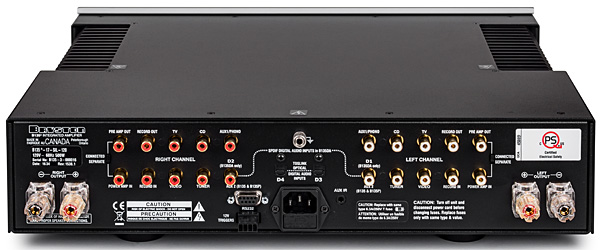
https://www.stereophile.com/content/bryston-b1353-integrated-amplifier
The system I was using to play William Basinski’s Disintegration Loops, as described in my intro, consisted of Roon’s Nucleus+ server connected (via Ethernet) to the dCS Bartók DAC, on into the B1353, which powered my Falcon “Gold Badge” LS3/5a speakers. On that recording, the sound was tone-neutral, not cool (as in my Bryston auditions at shows), and well-focused. The chief pleasure that day was the way the Bryston amplifier refused to get between me and the Basinski ambient experience.
That made me want to leave the Bryston in the system and forget about it, which I did, until, after three weeks of Bryston-only listening, I decided to compare it to the similarly priced ($7250) Pass Labs INT-25 integrated, which I have long regarded as the most transparent, naturally dynamic solid state amplification I’ve used.

 Audiophilepure
You must be logged in to post a comment.