Von Schweikert Ultra 55 loudspeaker $100,000 Review
June 25, 2020 Comments Off on Von Schweikert Ultra 55 loudspeaker $100,000 Review
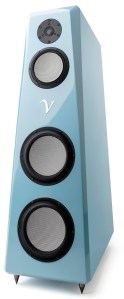
“Walk the halls at a hi-fi show and peer into the rooms. You’ll find numerous speaker brands using Accuton drivers all lined up on a front baffle. You could say to yourself, “Oh, another Accuton lineup, I know what that’s going to sound like.” But you really don’t. I’ve found huge sonic variations among such speakers, including ones I’ve reviewed and a few I haven’t but would like to.
Here, Von Schweikert opted to match Accuton woofers and midrange drivers with a Scan-Speak tweeter (modified in-house) and made them work and play well together to produce a rich, detailed, fully coherent, near–full-range speaker that was free of obvious sonic seams and never bored or engaged in a musical “cover up”: All the information is there, and it sounds great.”
Raidho TD1.2 Loudspeaker $24,000 Review
June 22, 2020 Comments Off on Raidho TD1.2 Loudspeaker $24,000 Review
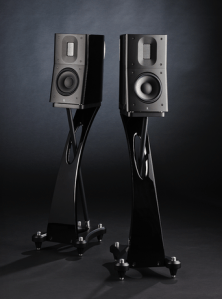
“The TD1.2 is the highest-performing, small, stand-mounted two-way loudspeaker I have heard—and I have heard some of the best. Its winning combination of exceptional overall resolution, expansive soundstaging, and musical swing in the form of lightning-fast and robust dynamics is just wonderful. This is a speaker for the two-way enthusiast who is willing to acquire the best of breed.
The Raidho TD1.2 appealed to my heart and head, to my musical soul and analytical reviewer self, and to my underdog-winning delight every time I heard it belt out stunning dynamic slam. Everyone who’s heard the speaker in my system loved it and marveled that such accuracy, lack of grain, and musical beauty came in such a small package. A marvel, indeed. Highly recommended.”
SteinMusic High Line Bobby M Loudspeaker Review
June 15, 2020 Comments Off on SteinMusic High Line Bobby M Loudspeaker Review
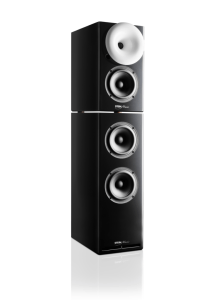
“There were a few other musical occasions where more slam would have been desirable, but obviously these are smallish speakers—even with the Bass Extensions in place—so there’s only so much one can expect given their driver complement and enclosure dimensions. That said, with their horns and other clever design elements, the Bobby Ms deliver more immediacy and nimble speed of attack than you might expect from speakers of this size. Reasonably powerful amplification benefits them, too.
The SteinMusic High Line Bobby M offered such pleasing and smoothly natural musicality and impressive dispersion that at times it was easy to forget I was listening to loudspeakers—a rare event. Nothing felt forced or aggressive. Any type of music I threw at the system just came through full of detail, with microdynamics galore, but without sterility, artificial spotlighting, or emphases in certain frequency ranges. I just wanted to keep on listening. Time seemed to pass as ephemerally as the soundwaves. No fatigue, either. ”
Magico A1 Loudspeakers $7400 Review
June 12, 2020 Comments Off on Magico A1 Loudspeakers $7400 Review
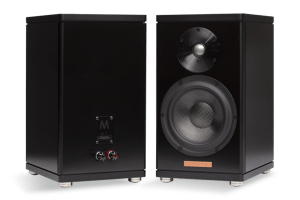
“Male voices got even healthier doses of presence from the A1s, which I liked — it made these little speakers sound even more robust. For example, in “Glow in the Dark,” from Iggy Pop’s Free (16/44.1 FLAC, Loma Vista), which I streamed from Tidal, Pop’s voice . . . well, it popped onto the soundstage with such fullness and presence that I had trouble reconciling it all with the A1’s size. Later in this track, the drums, set way back on the stage, enter strongly — through the A1s they sounded not only convincingly positioned 20’ back from the front of the stage, but reproduced with startlingly massive heft and fullness.”
ELAC Vela FS 407 Loudspeaker £3670 Review
June 11, 2020 Comments Off on ELAC Vela FS 407 Loudspeaker £3670 Review
“The new Vela FS 407 is a very capable floorstanding speaker, and one that shows ELAC is now able to deliver a broad spectrum of models that are right up with the best of their contemporaries. It performs the unusual trick of both being very appealing to look at, and to hear. Fast, lithe, agile, smooth, open and engaging, it works skilfully across a wide range of music, and so will surely have far reaching appeal.”

”
Wilson Benesch • Eminence Loudspeakers $235,000 Review
June 10, 2020 Comments Off on Wilson Benesch • Eminence Loudspeakers $235,000 Review
“The first point to make is that there are two distinct types of coloration, additive and subtractive. A little like odd and even-order distortion, subtractive coloration is relatively benign, whereas even small amounts of additive coloration can (and often do) wreak havoc. That’s because of the different ways in which they impact on the sense of the musical signal. The notes and different instruments in a recording constitute a three-dimensional pattern, laid out in space, time and amplitude. That pattern is what separates music from noise; it’s what a system is trying to reproduce and what our brain is trying to recognize. Subtractive distortion, as long as it is not too gross or specific, will diminish the scale or scope of that pattern, but leave it essentially intact. Once you start adding things to the pattern, especially because additive distortion is so often frequency-specific, you start to bend the pattern out of shape, so that it no longer makes sense. A bit of stored energy in a cabinet, arriving later than intended and at the wrong frequency? An energy spike in the structure of a poorly designed driver? Excessive bass output at particular frequencies? You can hear how they serve to alter not just the relative weight or amplitude of notes but their timing too — and that’s where things get destructive.”
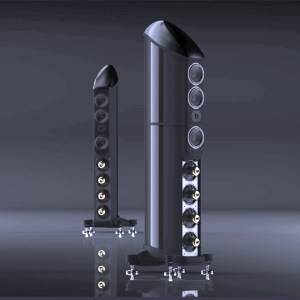
Audiovector R1 Arreté $5500 review
June 8, 2020 Comments Off on Audiovector R1 Arreté $5500 review
“It really is impressive just how bold and confident these speakers are when challenged with the music’s savage dynamics and dense instrumentation. The R1s stay composed even when pushed hard and barely harden-up in such circumstances.
Detail levels are as high as the price point demands, but the Audiovector’s musically cohesive way of assembling all that information really impresses. These are the kind of speakers that allow you to analyse the production of a recording if you want to, but they’d rather you step back and enjoy the musical experience.
When we listen to this Stravinsky piece we’re wrapped up in the musical drama rather than wondering about the mechanics of the recording. That’s just as it should be in our view”
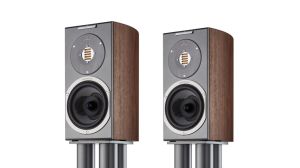
Von Schweikert Research VR-4 Loudspeakers Review
June 7, 2020 Comments Off on Von Schweikert Research VR-4 Loudspeakers Review
“Play most any recording taken from a concert hall or other large acoustic space and you will “feel” the pressurizing of the room with these speakers. It’s amazing how much ultra-low low bass information there is on many of these recordings and how much that information enhances the illusion of your room being that same concert hall. There is a down side, though. It can get a little disconcerting when you can plainly hear the rumblings of the air ventilation system or the traffic outside the recording site. I hear way too much of this on Chesky’s Johnny Frigo with Bucky and John Pizzarelli and the other recordings made at the RCA Studio “A” site in New York City.
Another down side is that a speaker that goes this low with real authority, will excite room resonances and standing wave problems much more than speakers that don’t move as much air or that have limited range. I don’t have resonance problems in my “audio bunker,” my room being underground with concrete under the floor and on all four walls, but I do have a standing wave problem at about 34 and 37Hz due to the long straight and diagonal lengths of my room. With the Wilsons, they’re heard as only minor peaks—with the VR-4s, they’re quite a bit more prominent. Not to worry though, the problem is nicely solved with a few of ASC’s 20″ tube traps or some of Tyll Hertsen’s (Mr. Headroom’s) home brew frequency specific cancellation tubes. Let’s face it, you have to pay your dues if you want killer bass with no peaks.”


You must be logged in to post a comment.