Sonus Faber Olympica Nova II $10000 review
June 5, 2020 Comments Off on Sonus Faber Olympica Nova II $10000 review
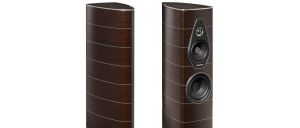
“I’d actually asked a friend over to help with some fine-tuning and tweaking, but it turned out it wasn’t necessary because the minute the music started playing, it was obvious that the positioning was perfect, not least because the soundfield I experienced was virtually holographic from the outset, so that there was no way I could localise the sound as issuing from the speakers. It was as if the speakers didn’t exist, just the musicians.
I have experienced this before, of course, but rarely so perfectly from such large multi-driver loudspeakers, because a prerequisite for this level of performance is that the left and right speakers are perfectly matched, so this must certainly have been the case with my review pair. And by holographic soundfield, I am referencing not just the stereo imaging, but also the height and depth of the soundstage. It was the sonic equivalent of a hologram.”
Focal Kanta No.3 $11999 review
June 4, 2020 Comments Off on Focal Kanta No.3 $11999 review
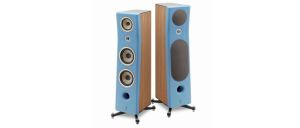
“The science of loudspeaker design is like any science: it obeys the law of diminishing returns. For anyone buying loudspeakers, this means that the more you pay, the better the sound will be, but there will eventually come a point at which the increased costs are not matched by similarly satisfying increases in sound quality.
The ideal is to find a speaker at the ‘sweet spot’ where the balance is just right for both your ears and your own budget. For me, the Focal Kanta No.3s represent that ‘sweet spot’. For you? You’ll obviously have to make that judgement for yourself – but I do sincerely recommend that you at least listen to a pair of Kanta No.3s… no matter what price you might originally have had in mind.”
Alta Audio Celesta FRM-2M Loudspeaker Review
June 3, 2020 Comments Off on Alta Audio Celesta FRM-2M Loudspeaker Review
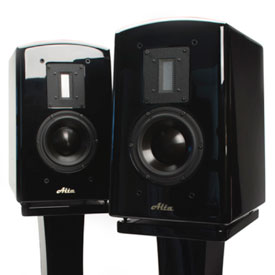
“Yes, that low frequency response figure in the Specs is correct. And spot on. The FRMs still plumb the depths like few stand mounts. They shock guests just how low they go with complete authority. Although mine is a small listening room, it is fully pressurized by Levy’s XTL technology. I’ve heard the same effect wow listeners in two NYC listening rooms larger than mine. And, the bass is timbrally accurate—no cheap thrills or mid bass bumps like many bookshelf loudspeakers. As such, you’ll hear the Kingsway rumble from the Picadilly Line tube on the Martinon/LSO/Shaded Dog/Shostakovich 1st Symphony clearly and the wiry sound of Ray Brown’s string bass when bowed on We Get Requests.”
12 of the world’s most expensive loudspeakers
June 2, 2020 Comments Off on 12 of the world’s most expensive loudspeakers
“Horn speaker specialist Cessaro Horn Acoustics has a top of the range model which is 2.8m tall and weights 4.5 tonnes. Just in case you were wondering, The Omega I system is not meant for normal living rooms, according to the website. You haven’t got one of those, have you?
Six 40cm bass units drive the front-loaded horns which, you’ll be pleased to hear, can be ordered in any colour you choose. Equally, the cabinets and side panels come in a pretty extensive range of veneers. ”

Magnepan LRS Loudspeaker $650 Review
June 2, 2020 Comments Off on Magnepan LRS Loudspeaker $650 Review
http://www.theabsolutesound.com/articles/magnepan-lrs-loudspeaker/
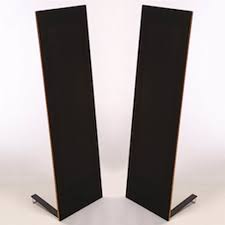
“At $650 the LRS is an easy top recommendation. It will need considerable power and careful placement to perform at its best—and frankly it will also need a decent subwoofer if you want full-spectrum fidelity. But if you’re listening in a smallish room and are a fan of folk-rock or acoustic music, it will outdo anything else at or near its price. No matter how much you spend on your stereo, getting it to sound like the real thing isn’t a given, folks. In the midrange, the LRS sounds like the real thing.”
Elipson Prestige Facet 34F £2,500 Review
June 1, 2020 Comments Off on Elipson Prestige Facet 34F £2,500 Review
“Best of all, Elipson hasn’t thrown everything at the bass and midrange and forgotten about the treble. The top end is deliciously sweet and insightful, but without any sense of hardness that could ruin the whole delicate balance. Admittedly, it can’t quite match the ultimate purity of Bowers & Wilkin’s similarly priced 703 S2 floorstander (HFC 433), for example, but there is never a sense that I am missing anything. The guitar string plucks from Nickel Creek’s Reasons Why are beautifully defined and the subtle percussion effects backing Aaron Neville on Everybody Plays The Fool are present, correct and easy to distinguish.”
Estelon YB Loudspeakers $22,500 Reviews
May 28, 2020 Comments Off on Estelon YB Loudspeakers $22,500 Reviews
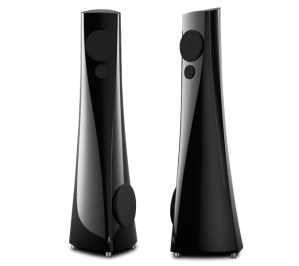
“As I’ve just implied, some speakers can simulate soundstage depth by recessing the midrange. The YBs were above such trickery. If I had to venture a guess as to how these speakers mastered space so well, I’d say it’s everything about them — their rounded, organically shaped, exceptionally dead cabinets, high-quality drive units, and good engineering. None of these characteristics are unique to Estelon, but the combination of them in so elegant a package verges on the stunning.
The owner’s manual hints that it’s best not to overdrive these speakers and thus risk driver failure. Well, far be it from me to second-guess the manufacturer, but I pushed these babies pretty damn hard at times, and never once heard from them the slightest whimper of distress: no compression, no hardening, no distortion of any kind — instead, for the most part, only a direct relationship between the position of the volume knob and the volume of sound coming from the speakers. Turn it up, it got louder. Not sure what the fuss is about here.”
Bowers & Wilkins 803 D3 Unboxing and Setup
May 25, 2020 Comments Off on Bowers & Wilkins 803 D3 Unboxing and Setup
Eikon Audio Image1 Integrated Loudspeaker System $25,000 Review
May 22, 2020 Comments Off on Eikon Audio Image1 Integrated Loudspeaker System $25,000 Review
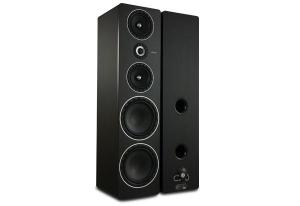
“The two high-excursion 8″ woofers are loaded in an unusual quasi-transmission-line arrangement. In a full transmission line, the woofer’s rear wave is directed down a labyrinth filled with mineral wool (or other damping material) inside the cabinet. The woofer’s rear wave is dissipated as it travels down the labyrinth, and in theory is completely dissipated at the end of the transmission line (the opening in the speaker enclosure that looks like a port). A transmission line avoids the problem of sealed loading in which the trapped air inside the enclosure acts as a spring against the woofer as the woofer moves in. It also avoids the problem of reflex (ported) loading in which transient behavior is compromised and port artifacts (resonances, the sound of air moving through the port, etc.) can become audible. Although a transmission line has none of these problems, a true transmission line requires an enormous cabinet enclosing a very long labyrinth to fully dissipate the woofer’s rear wave. In a quasi-transmission line such as in the Image1, some woofer energy emerges from the end of the line, but it is greatly attenuated. The Image1’s transmission line gets progressively narrower, forcing the energy into a smaller and smaller area that has progressively greater damping. Sanders says that this unusual approach delivers tighter bass than traditional sealed or reflex loading.”


You must be logged in to post a comment.