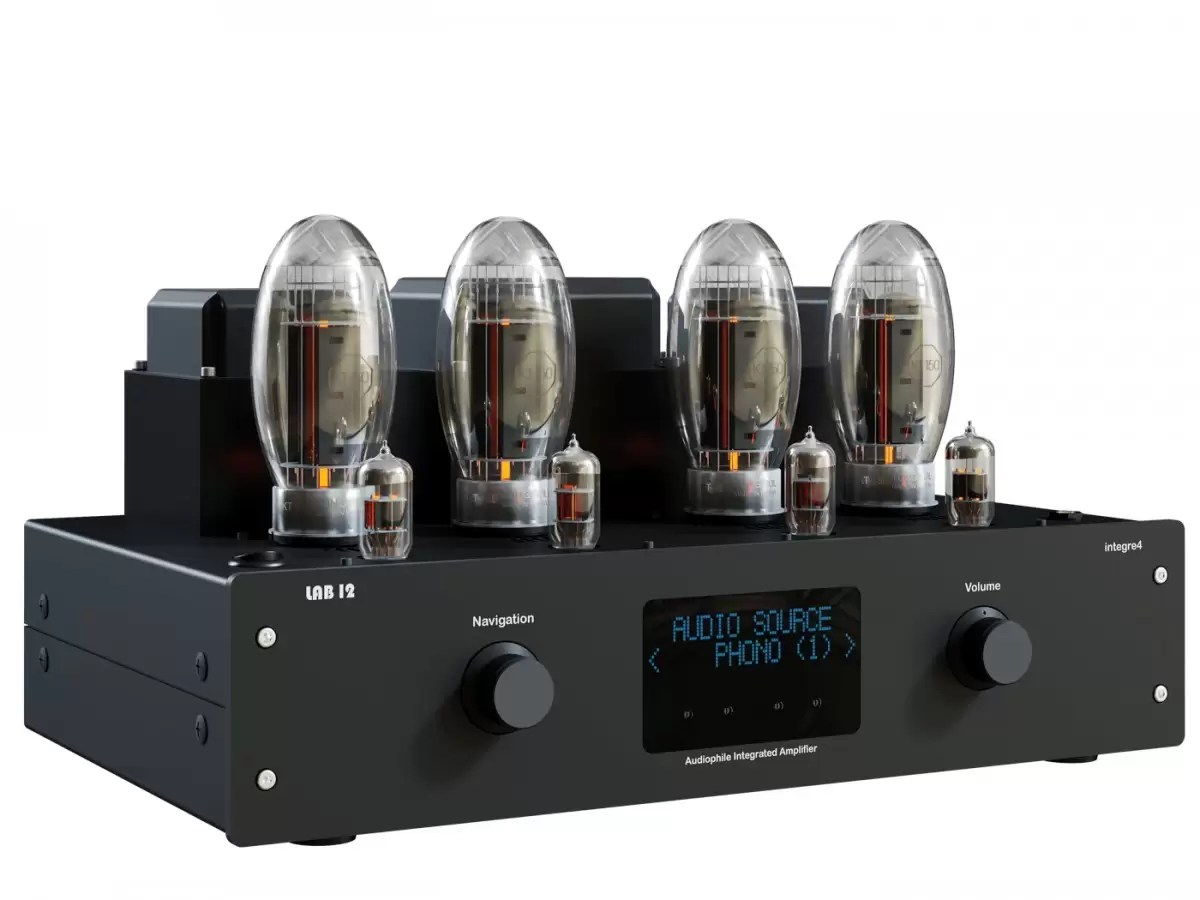
Lab12 Integre4 Integrated Amplifier | REVIEW
June 26, 2022 Comments Off on Lab12 Integre4 Integrated Amplifier | REVIEW
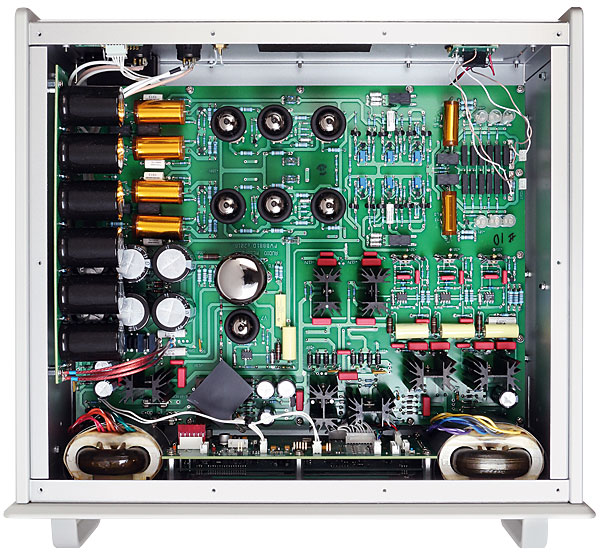
I’m trying so hard to wean myself off the idea of prices in high-end audio, because we all have to get over the idea that the cost of approaching perfection is downright prohibitive—mostly because it takes a lot of money to get there. But here we have an amplifier, an integrated amplifier even, that costs just $4,450, and it helps me to attain joy and happiness at the same level as some very pricy gear. It’s also beautiful, well-made and it has enough power to drive most speakers. For every audiophile who loves to complain about the high price of quality hi-fi, I’m throwing you a bone here.
Is the Lab12 Integre4 perfect? I don’t know if I need perfect in an integrated amplifier. I have another integrated amplifier in mind, the LFD NCSE I reviewed a couple of years ago, and it was pretty close to perfect, too. I wouldn’t mind having some XLR compatibility with the Integre4 simply because I have so many XLR cables hanging around, waiting to be tested. This omission would never prevent me from pulling the trigger, however, since the sound quality speaks to me with such eloquence.
Focal Clear Mg Headphone Review
June 26, 2022 Comments Off on Focal Clear Mg Headphone Review
the first thing I noticed about the Clear Mg was its exquisite tonal balance. While some may find Focal’s lively tuning of the presence region (upper mids) a little too forward, I reveled in it, as it brought any music I played through these headphones to life.

JansZen Valentina P8 loudspeaker $9250 Review
June 25, 2022 Comments Off on JansZen Valentina P8 loudspeaker $9250 Review
https://www.stereophile.com/content/janszen-valentina-p8-loudspeaker
The reason I discussed the setup of the JansZen Audio Valentina P8 at such length was that this is a speaker that requires such attention to detail in order to get it to sing. But as I found in my auditioning, when everything is just right, this made-in-America loudspeaker can indeed sing, as long as you are in the sweet spot. I particularly appreciated the detailed, transparent midrange and treble, the articulate, reasonably extended low frequencies, and the well-defined imaging. To repeat J. Gordon Holt’s words about the 1966 JansZen speaker, the Valentina P8 offered a “musically natural window” to the sound of my favorite recordings. And I must include a tip of the hat to David Janszen for his comprehensive manual, which I found essential during the setup process

PureAudioProject Quintet15 Speaker System $11,140 Review
June 24, 2022 Comments Off on PureAudioProject Quintet15 Speaker System $11,140 Review
What can I say more about these that I haven’t already covered in the Trio review? They are more of everything! Volume, heft, SPL, and stature. If that is what you’re looking for—you came to the right place. And don’t worry about your room size too much—honestly, due to them being dipoles, you can run them in awkward rooms and get very pleasurable nearfield listening out of them. I can say this with actual experience (they currently are living in a 22′ x 12′ room) so they are quite versatile. If you have the Trios, consider this a major upgrade (if your room allows it) or if you’re considering a PAP system then I say skip the smaller one and just go with these! I can’t recommend the company or the speakers enough.

Monet Power Cable from Crystal Cable $6190 Review
June 24, 2022 Comments Off on Monet Power Cable from Crystal Cable $6190 Review
The Monet defied the silver stereotype. The lower-midrange and bass bands are well represented, even slightly favored. Secondly, images are endowed with healthy amounts of body and far from being model-slim. Third, the tonal temperature veers slightly to the warm side. About the only things that did conform to the silver stereotype were the sweet timbres and musicality. Placing the Monet on the often used analytic/musical metric, it would land to the musical side.
Audiophiles are always chasing the twin muses of resolution and musicality. One doesn’t readily encounter strong performance in both from a single product. The Monet Power Cable gives you the whole package and delivers a performance that would easily hold its own in a field of competitors at the $10K/2m range.

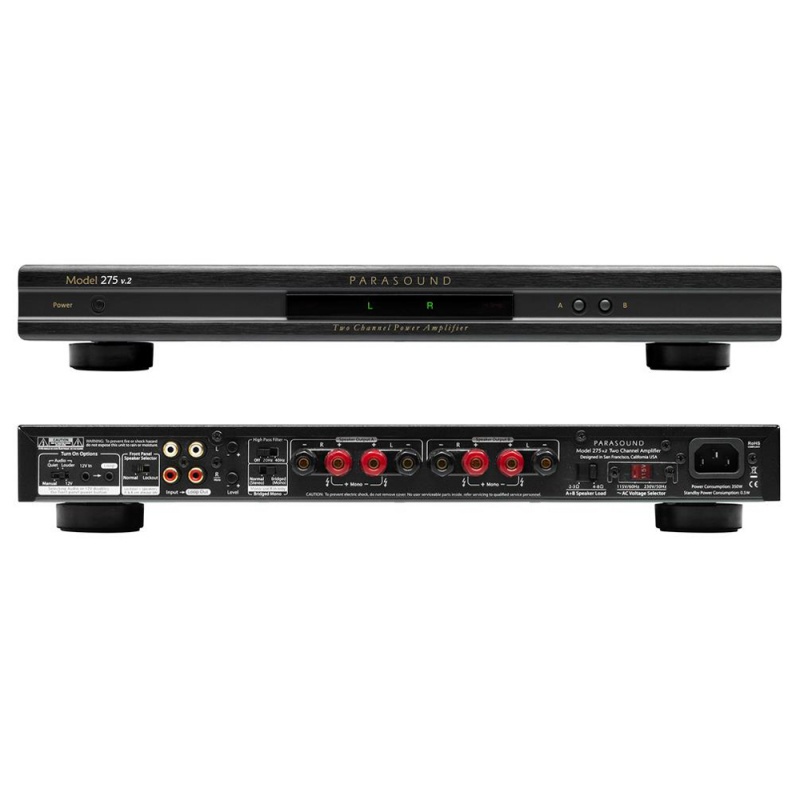
Parasound NewClassic 275 v.2 two channel power amplifier $899 Review
June 24, 2022 Comments Off on Parasound NewClassic 275 v.2 two channel power amplifier $899 Review
Turning to analog, I used the Goldring turntable with the Talisman low output moving coil cartridge in this system. I set the iFi ZEN phono stage to the high output moving coil setting due to the high gain of the Antique Sound Lab line stage. I started with my Los Angeles Orange County Audio Society 25th Anniversary album and the Shoji Yokouchi Trio. I also played some Steely Dan. Playing these records gave me a similar sound to my Quicksilvers. I have to admit I do enjoy “tube rolling” with the Quicksilvers, which allows me to alter the sound with a variety of different tubes.
The Parasound NewClassic 275 v.2 power amplifier with 90 watts per channel into 8 ohms and 150 watts per channel into 4 ohms should be enough to drive most speakers unless you have some really low-efficiency or otherwise difficult-to-drive speakers. This power amplifier is so well designed that it worked well with any speaker that I threw at it. You could also consider Parasound NewClassic’s other power amplifiers if you want more power. This includes both the 2125 v.2 (150 watts 8 ohms/ 225 watts 4 ohms, $1,099) and the really powerful 2250 v.2 (275 watts 8 ohm/ 400 watts ohms, $1,799) power amplifier.

KEF Blade One Meta Loudspeaker £33,000 Review
June 23, 2022 Comments Off on KEF Blade One Meta Loudspeaker £33,000 Review
https://www.hifinews.com/content/kef-blade-one-meta-loudspeaker
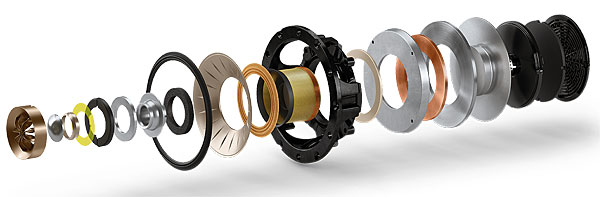
At the heart of the Blade One Meta is the latest version of the Uni-Q, now in its 12th generation and complete with KEF’s Metamaterial Absorption Technology – also used in the company’s updated Meta versions of its Reference series. The driver combines a 25mm dome tweeter with a stiffened dome and a revised tweeter gap damper to accommodate the metamaterial absorber behind it. This circular device uses a complex maze-shaped structure of channels to absorb a claimed 99% of the sound from the rear of the tweeter – or, as KEF puts it, it acts as ‘an acoustic black hole’ – to give a purer, cleaner mid/treble output [for a deep dive into Meta, see HFN Jun ’21].
Finally, the company’s familiar ‘tangerine’ segmented waveguide is used to control, and widen, treble dispersion. The tweeter sits in the throat of a 125mm aluminium-cone midrange unit with a new motor designed for extremely low distortion. The surround is redesigned to allow longer excursion while the profiles have been reworked to smooth the transition from the face of the driver to the cabinet geometry.


Audio Research REF Phono 3SE Phono Preamplifier review
June 23, 2022 Comments Off on Audio Research REF Phono 3SE Phono Preamplifier review
https://www.hifinews.com/content/audio-research-ref-phono-3se-phono-preamplifier
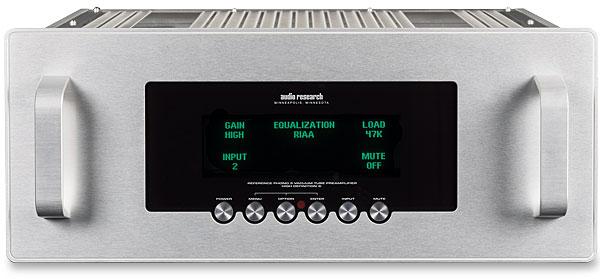
I don’t play trumpet. I cannot tell you what Miles used, or which saxes Adderley and Coltrane were blowing, but the sense of realism, the presence was enhanced to a degree that can only be attributed to – as Dave Gordon surmised – ‘The extremely low-level nature of the signals … [accounting] for what we consider a startling improvement’. And ‘startling’ is the perfect adjective for what I was hearing.
What can be dismissed from the outset, especially for those who are not diehard MM or MC fans without considering the alternative, is that there was no discernible preference for one over the other. Moreover the gain was such that high output MCs could easily be used via the Low Gain/47kohm setting with little loss of dynamics. I played four or five tracks with a London Gold, followed by an Ortofon 2M Bronze, then a Kiseki Blue [HFN Jul ’18], and lastly the Sumiko 40th Anniversary MC, all as a test.
FIR AUDIO XENON 6 $3,899 REVIEW
June 22, 2022 Comments Off on FIR AUDIO XENON 6 $3,899 REVIEW
My Xe6 has translucent smoke shells combined with their Titanic faceplate. It features the FiR Audio company logo on the left, and the Xe6 product logo on the right side – both in silver. It’s a simple design, but I like it.
All in all I am very content with the build quality of my customs. They sit nicely tight in my ears and don’t cause any pressure. I have been wearing these for hours on end, and have not felt any discomfort.

FYNE 500SP $1,995 Review
June 22, 2022 Comments Off on FYNE 500SP $1,995 Review
The FYNE 500SP
One thing unique to the FYNE speakers is their fifth ground lug on the back of the speakers. FYNE claims it will “ground the driver chassis and eliminate amp or cable born RF interference.” While the TONE studio is a big, metal building (essentially a Faraday cage), we don’t usually have this problem. However, in the house’s unshielded environment, taking advantage of this did make a slightly noticeable – and positive effect. A nice touch, indeed.
While the review set arrived in gloss black, gloss white, and gloss walnut is also available. The finish quality is exquisite. The 500SPs are designed and built in the UK. It shows. If you’ve spent any time at all with modestly priced speakers that hail from China, you’ll notice that the fine details are not executed as well as they are here.
Should you put a pair of 500SPs in your system, the only thing you might consider after you’re used to the speakers is a pair of high-quality jumpers to connect the woofer and tweeter, if you aren’t using bi-wired speaker cables. Jumpers from Tellurium Q and Cardas both added another margin of HF smoothness that is worth exploring.


You must be logged in to post a comment.