Q Acoustics Q Active 200 Loudspeaker Review
January 10, 2022 Comments Off on Q Acoustics Q Active 200 Loudspeaker Review
https://www.soundandvision.com/content/q-acoustics-q-active-200-loudspeaker-review
To sum up, Q Acoustics’ Q Active 200 system is a fascinatingly different design, and I enjoyed my sojourn with it. It’s dead-perfect for the listener who might otherwise buy a brand-S or brand-B (or a Google or Amazon or Apple) all-in-one, but desires, and is willing to pay for, something much better, which this system most decidedly is. Could you, for the same money, get a bit better performance from conventionally wired passive speakers? Certainly, but you will sacrifice the integration, simplicity, and, of course, wireless-ness. And you’ll need to spend significant bucks for sources and for amplifiers as well. For anyone who finds the Q Active 200’s just- add-music concept alluring, I strongly recommend pursuing a serious audition.
MartinLogan ElectroMotion ESL X Loudspeaker £4995 Review
January 9, 2022 Comments Off on MartinLogan ElectroMotion ESL X Loudspeaker £4995 Review
https://www.hifinews.com/content/martinlogan-electromotion-esl-x-loudspeaker
This is more observation than criticism, as I’m wary of expecting too much from a loudspeaker at this price that performs so admirably in other areas. For instance, the EM-ESL X steers clear of HF nasties. Hi-hats and cymbals were always distinct and well separated, avoiding splash or brightness. Metallica’s ‘Dyer’s Eve’, which closes an album famed for a treble-heavy ‘scooped’ guitar tone […And Justice For All; Vertigo 836062-2] was perhaps more listenable than I’ve ever heard it, helped by the EM-ESL X’s speedy transducer keeping its frantic rhythms and riffs astonishing clear.
Lastly, for a simple five-minute demonstration of what this loudspeaker can do, give Elton John’s ‘Honky Cat’ [Honky Chateau; Mercury 528 162-2] a whirl. Huge piano accompaniment, dynamic trombone and saxophone hits, a drum track that sounds almost three-dimensional and Reginald Dwight throwing out rhyming couplets right into your listening room. It sounded… electrifying.

ZELLATON Plural Evo Loudspeakers $69,750 Review
January 7, 2022 Comments Off on ZELLATON Plural Evo Loudspeakers $69,750 Review
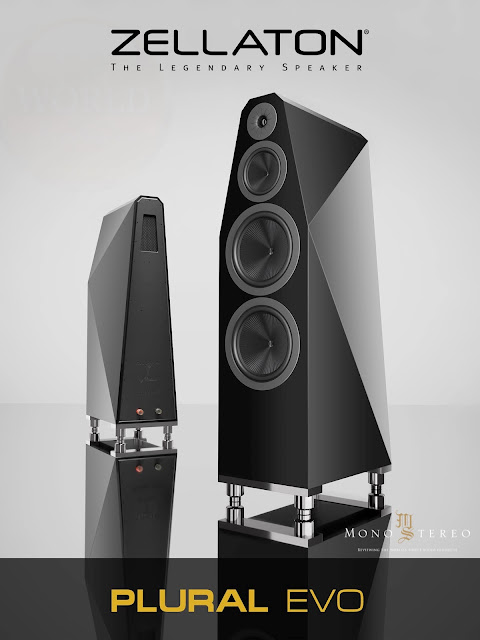
Digging down a little deeper into the cabinet design reveals another type of sandwich. The Plural Evo cabinet is made of three different types and layers of wood to reduce the material’s sound. These include high quality MDF, armored wood sandwich and vibration insulation. The woods are of different thicknesses and key positions in the cabinet are reinforced with metal plates. Internal reinforcements and bracing are asymmetrical throughout to reduce cabinet vibration to an absolute minimum. ZELLATON uses a special Laser Doppler vibrometer to measure the speaker’s vibrations down to the square centimeter.
Finally, ZELLATON eschews conventional philosophy of spiking speakers and prefers instead to use coupling in concert with energy draining. ZELLATON in the Plural Evos opted to use rounded feet on the bottom of the speaker in concert with discs reduce energy; a side benefit is this works better with carpeting.

Vimberg Tonda D $39,500 Review
January 6, 2022 Comments Off on Vimberg Tonda D $39,500 Review
This acoustic lends itself to capturing the direct timbre of the cello without too much of the hall’s sound influencing what is being played—thus avoiding a wetter presentation. The Tonda D was able to convey the realistic sound of the cello as heard at the microphone. The bowing motion and direction changes, fingering, and intricate sound of the action of playing were all startlingly apparent, if one chose to focus on those aspects. On the other hand, the listener could just immerse himself in the music, and enjoy the incredibly stark contrasts in Ligeti’s composition (and Rosselet’s playing) between the delicately flowing Dialogo and spritely, aggressive Capriccio, which was written several years later. The Tonda D captured it all, and delivered the goods as Frederic Rosselet poured his passion and skill into the performance.
In closing, the Tonda D has a sleek and refined appearance to match its sound. Like the lovely and refreshing feel of an early morning breeze in the heat of summer, the Tonda D reproduces music with a cooling, fresh, pure, and welcoming vibe. As a result, well-produced music sounds great, mediocre music sounds mediocre, and less than well-engineered music has no place to hide. The three different playback sources (digital, vinyl, and 15ips reel-to-reel tape) used in listening examples above show the Tonda D to be capable of revealing multiple delights and contrasts with different genres of music. While staying generally neutral in presentation, the influence of upstream components, room interaction, and the music itself are what the Tonda D most clearly presents to the listener. This level of transparency is often craved by listeners who value fidelity to sources. If that is you, the Tonda D should be on your audition list.

B&W 801 D4 Loudspeaker Review
January 5, 2022 Comments Off on B&W 801 D4 Loudspeaker Review
https://www.hifinews.com/content/bw-801-d4-loudspeaker
By contrast, the big slam of the opening of Yes’s ‘Yours Is No Disgrace’ [The Yes Album; Atlantic WPCR 15903, DSD64] just cannons out from the speakers. The complex keyboards and driving, grumbling bass line fuse with the drums to drive the track relentlessly, and those harmonies are wide-open, as are the words – for good or bad! Yes, the soundscape is huge here, and the low end from those two aerofoil drivers is both punchy and remarkably controlled. These speakers will also go scarily loud with enough amplification driving them, but they remain resolutely clean and clear – a fitting apex to B&W’s latest 800 Series Diamonds.


PSB Synchrony B600 Loudspeakers Review
January 4, 2022 Comments Off on PSB Synchrony B600 Loudspeakers Review
Diego wrapped up his review by asking the question: “What’s not to like about the PSB Synchrony B600?” His answer was “nothing,” and Diego added that the B600 “is one of the most complete-sounding small speakers” he’s ever heard. As a result, the B600 was presented with a Reviewers’ Choice award at the time of his review for its outstanding sonic performance—and that’s also why the B600 is being recognized as a Recommended Reference Component this month.

Bowers & Wilkins Diamond Series 804 D4 loudspeaker $12,500 Review
January 2, 2022 Comments Off on Bowers & Wilkins Diamond Series 804 D4 loudspeaker $12,500 Review
https://www.stereophile.com/content/bowers-wilkins-diamond-series-804-d4-loudspeaker-page-2
Having visited Bowers & Wilkins’s research facility and factory in England, I believe their engineers can design a loudspeaker to sound and measure any way they wish. From my experience, not just with the 804 D4 but with the 705 Signature—where I wrote, “I was surprised how much I enjoyed having the Bowers & Wilkins 705 Signature in my system … because the speaker’s measured performance implies a somewhat ‘tailored’ sonic character”—both the 804 D4’s measurements and its sonic signature indicate that achieving a classically flat and neutral tonal balance à la Floyd Toole’s writings was not the design team’s primary goal. Instead, clarity, transparency, low-frequency articulation, and the absence of midrange coloration seemed to have had a higher priority.
Even after I had measured this loudspeaker, the issues I found seemed to step out of the way of the music much of the time. Those port resonances seemed to have very little effect on midrange clarity, and while I was occasionally aware that the resonance just below 4kHz was adding some presence-region emphasis, it did not seem to be excited with most recordings. The extreme toe-in recommended in the manual reduced the audibility of the excessive treble, though the speaker’s high-frequency balance will make system matching more difficult than usual. And combined with the speaker’s high impedance in the mid-treble, it will make tube amplifiers sound overbright.

Fink Team KIM Standmount Loudspeaker Review
January 1, 2022 Comments Off on Fink Team KIM Standmount Loudspeaker Review
https://www.stereonet.com/au/reviews/fink-team-kim-standmount-loudspeaker-review
Karl-Heinz then tried using a higher resistance inductor and another resistor in series to change the speaker’s alignment even more. “We can switch between 0.5 ohm, 0.25 ohm, and nothing, so this can be used to tailor your speaker to different amplifier technologies. A modern transistor amp has a high damping factor, so you use the larger resistor setting, while more traditional amplifiers like Naim normally use a smaller resistor in series, so the middle position is correct. And the left option is for tube amps; this works well with push-pull designs and helps with the bass.”
I found the KIM to be unusually easy to position in my room. Standing about 30cm out from the boundary wall on its 6mm carpet-piercing spikes doing their thing, it integrated very well and didn’t boom in the bass unduly. I alternated between the high damping factor and middle positions as I switched between my Rotel Michi X-5 and Exposure 3510 amplifiers, fed from a Chord Electronics Hugo TT2 DAC.

Vimberg Tonda D Review
December 27, 2021 Comments Off on Vimberg Tonda D Review
General impressions of the Tonda D show the speakers to have notably excellent imaging, resolution, detail retrieval, transient behavior, dynamic contrasts, and undiminished energy as one goes higher in the frequency range. The sound is smack dab in the middle area of balanced playback, with an ever-so-slight tilt towards the cool side of neutral in my particular setup. Much of that ever-so-slight tilt can be attributed to my personal preference for a smidge more lower midrange fullness, and because my listening room refuses to overload with bass (a good thing, IMO), where a smaller and more enclosed space would fill that particular cup a bit more completely. None of these preferences detracted from my enjoyment of the Tonda Ds’ excellent performance during their time here.

ZELLATON Plural Evo Loudspeakers $69,750 Review
December 24, 2021 Comments Off on ZELLATON Plural Evo Loudspeakers $69,750 Review
The midrange driver in the Plural Evo is used as a “widebander” and operates over a frequency range from roughly 90 to 7500 Hz. In short, the midrange driver is asked to do a lot. Low octaves in the Plural Evos are handled by two 11-inch drivers. “The woofer gives weight to the bass and helps to match the speaker to the size of the room,” said Michael. “There’s no compromise and the Plural Evos can play all types of music and capture a wide range of volumes from orchestra to small scale ensemble. All of this distortion free,” he emphasized.
The woofer in the Plural Evos, unlike the Klassik Series speakers, is open to the floor. “This arrangement,” said Michael, “helps the speaker better integrate into smaller rooms and allows them to be placed closer to walls.” Note that the speakers come “left” and “right” and should be placed so the vent at the bottom is placed to the inside, not outside of each speaker. Everything matters and Plural Evo owners are provided with two pair of rectangular foam pieces, one a little wider than the other, to help tune the speaker to the room. “The narrower piece,” Michael explained, “gives a more precise sound vs the wider piece that give a fuller sound.” For instance, the narrower foam in my room resulted in a more two-dimensional, flatter and compressed sound relative to the wider piece of foam. (But as Gideon pointed out, the narrower piece of foam might be the better choice in a larger room.) Inserting the wider piece of foam all the way into the slot on the bottom of the speaker reduced the bass output and lead to a loss of detail; by contrast, pulling the wider piece of foam as far out as possible produced a more detailed yet less “breathable” sound. So, the final position in my listening room was somewhere between the two extremes.


You must be logged in to post a comment.